
Christianity is the predominant religion in the Federated States of Micronesia (FSM), making up approximately 95% of the population. The faith serves as an integral part of the nation’s social and cultural identity, backed by a secular constitution that strictly guarantees freedom of religion.
Denominational Demographics
The population is split almost evenly between two major Christian traditions:
- Roman Catholicism (55%): The dominant denomination across the region.
- Protestantism (42%): Primarily represented by the United Church of Christ (Congregationalist).
- Minority Denominations (2%): Includes Baptists, Assemblies of God, Seventh-day Adventists, the Church of Jesus Christ of Latter-day Saints (Mormons), and Jehovah’s Witnesses.
State-by-State Distribution
Religious affiliation heavily depends on geographical region and traditional clan lines:
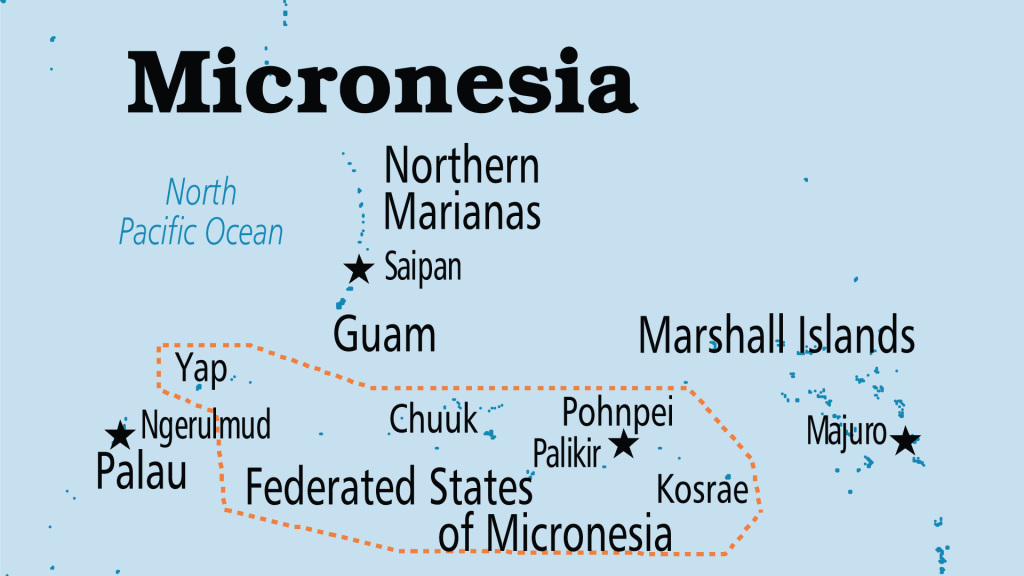
- Kosrae: Almost entirely Protestant (roughly 90%).
- Yap: Heavily Roman Catholic (roughly 80%).
- Chuuk: Majority Roman Catholic (60%) with a strong Protestant minority (40%).
- Pohnpei: Divided evenly; Protestants heavily populate the western side, while Catholics cluster on the eastern side.
Historical Roots
- Catholic Introduction (1668): Spanish Jesuits arrived to evangelize the Mariana Islands. Despite intense early conflicts (the Chamorro-Spanish wars), Catholicism quickly anchored itself as the primary faith in the western islands.
- Protestant Arrival (1852): American Congregationalist missionaries, supported by Hawaiian partners, established roots in Pohnpei and Kosrae. They trained indigenous teachers to spread the gospel westward into Chuuk and the Marshall Islands.
- Rapid 20th-Century Growth: By the end of World War II, traditional animistic practices had mostly shifted to the background as nearly the entire population formally adopted Christianity.
Church and Local Culture
Today, the church is a localized institution seamlessly woven into daily Pacific island life. However, a unique religious syncretism exists. An estimated 2.7% of citizens formally practice folk religions, but many more informally blend Christian theology with indigenous ancestral beliefs, traditional medicine, and spirit divination. Historically, missionaries forced strict cultural breaks—such as banning sakau (kava) on Pohnpei or outlawing traditional tattoos in the Marshalls—but modern Micronesian churches openly celebrate indigenous music, language, and custom.
Links for further overview of Micronesia:

