

Christianity is the predominant religion in Cyprus, with its adherents comprising roughly 73% to 78% of the island’s total population. The overwhelming majority of Cypriot Christians belong to the Church of Cyprus, an ancient, autonomous branch of Eastern Orthodoxy.
The Church of Cyprus (Eastern Orthodoxy)
The Church of Cyprus serves as a core anchor of Greek Cypriot national, linguistic, and cultural identity.
- Demographics: Approximately 74.5% of the population in the government-controlled southern region identifies as Eastern Orthodox.
- Autocephalous Status: The church is entirely self-governing (autocephalous), meaning it elects its own Archbishop independently of any higher patriarchate. This status was officially granted at the Council of Ephesus in 431 AD.
- Cultural Presence: Daily life is structured tightly around the liturgical calendar, major feast days (like Orthodox Easter), and local patron saint festivals (panigyria).
Other Christian Denominations
While Orthodoxy dominates, Cyprus is home to several historic and minority Christian communities:
- Roman and Latin Catholics: Represent about 1.5% of the population.
- Maronite Catholics: An Arabic-speaking Catholic community originating from Lebanon and Syria that has retained a distinct identity for centuries.
- Armenian Apostolics: A community dating back to the Byzantine era, practicing under the Armenian Apostolic Church.
- Protestants & Anglicans: Small active communities consisting primarily of British expats, evangelicals, and Turkish-speaking Protestants.
Biblical & Historical Roots
Cyprus holds a monumental place in early Christian history, being the first country outside mainland Palestine to receive the Christian gospel.
- Apostolic Missions (45 AD): Christianity was brought to the island by the Apostles Paul, Barnabas, and Mark. St. Barnabas was a native Cypriot born in Salamis.
- First Christian Ruler: While preaching in Paphos, Paul and Barnabas converted the Roman Proconsul Sergius Paulus, making Cyprus the first Roman province governed by a Christian.
- Saint Lazarus: According to Christian tradition, after Lazarus was raised from the dead by Jesus, he fled to Cyprus to escape persecution, became the first Bishop of Kition (modern-day Larnaca), and lived there for 30 more years.
Geopolitical Division and Impact on Religion
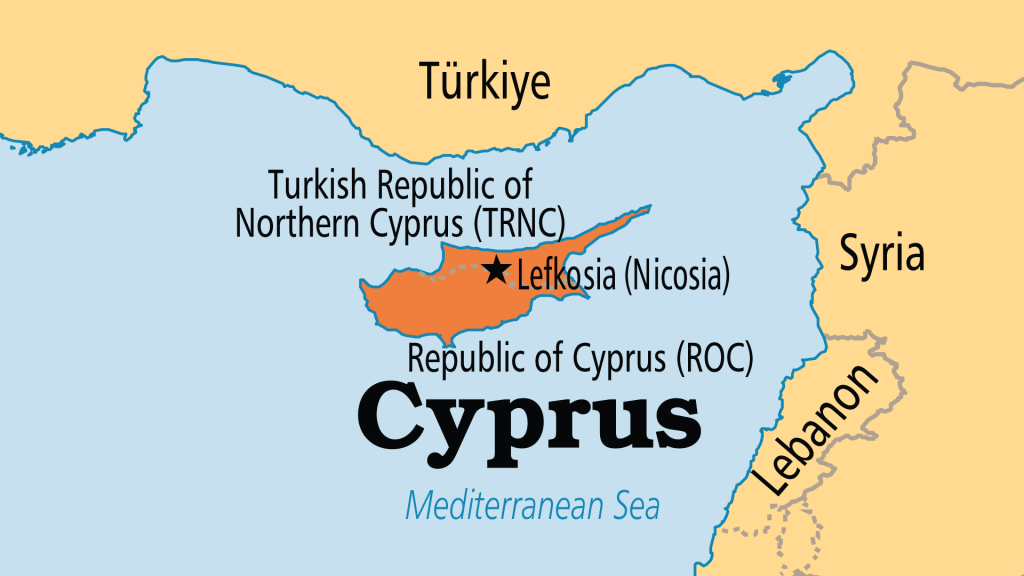
The geographic distribution of Christianity has been starkly impacted by the 1974 political division of the island:
- The South (Government-Controlled Area): Predominantly Greek Orthodox Christian.
- The North (Turkish Cypriot Administered Area): Predominantly Sunni Muslim. Following the 1974 displacement, almost all Christian populations left the north. Dozens of historic churches and monasteries (such as the St. Barnabas Monastery near Salamis) were abandoned, converted into museums, or fell into disuse
Links for further overview of Cyprus:

