
Christianity is the predominant religion in the Solomon Islands, with over 90% of the population identifying as Christian. The arrival of missionaries in the 19th and early 20th centuries radically transformed the social and cultural landscape of the islands, replacing many traditional indigenous practices. Today, churches play a vital role not just in spiritual life, but in providing education, healthcare, and community leadership throughout the country.
Major Denominations
The religious makeup of the Solomon Islands is diverse, with several distinct denominations making up the majority of the population. According to national census data, the largest groups include:
- Anglican Church of Melanesia: The single largest denomination, accounting for roughly 32% of the population.
- Roman Catholic Church: The second-largest group, making up about 19% to 20% of the population.
- South Seas Evangelical Church (SSEC): An evangelical, Pentecostal church that accounts for around 17% of the population.
- United Methodist/United Church: Representing about 10% to 11% of the population.
- Seventh-day Adventist (SDA) Church: Accounting for roughly 11% to 12% of the population.
- Others: Smaller groups include the Christian Fellowship Church, the Church of Jesus Christ of Latter-day Saints, and the Baha’i Faith.
Civic & Social Influence
Churches are deeply woven into the fabric of daily life and governance in the Solomon Islands.
- The Solomon Islands Christian Association (SICA): This ecumenical organization comprises the five largest Christian churches. It is highly influential and organizes joint prayers during independence celebrations and national prayer events.
- Education and Healthcare: Because the national government does not have the resources to fully manage rural services, the major Christian churches run many of the country’s schools and health centers, subsidized by the government.
- Political Leadership: Prominent politicians, and even former Governor-Generals, have been ordained members or former archbishops of the local churches.
Indigenous Beliefs and Syncretism
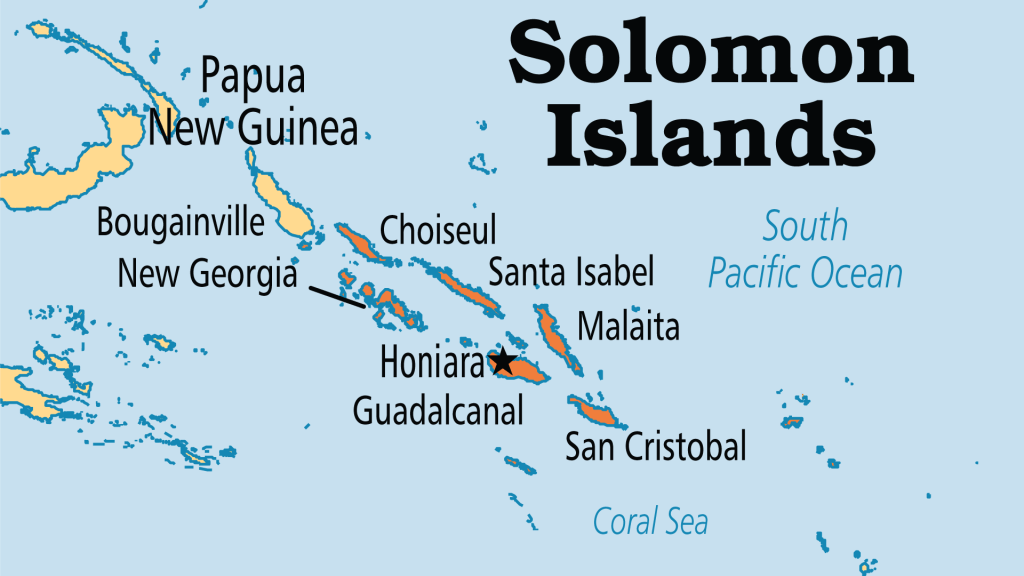
While Christianity is the national norm, roughly 5% of the population still practices traditional indigenous animistic religions. This is particularly true within the Kwaio community on the island of Malaita, who have largely resisted conversion.
In some areas, there is a degree of syncretism, where traditional indigenous customs and ancestral respect blend naturally with Christian teachings.
Religious Freedom
The Constitution of the Solomon Islands guarantees freedom of religion. The government respects this right, and members of different denominations—as well as minority religions like Islam—coexist peacefully. Religious education is part of the public school curriculum, though it is optional and the content is determined by SICA.
Links for further overview of the Solomon Islands:

