
Armenia holds the distinction of being the first nation in the world to adopt Christianity as its state religion, an event traditionally dated to 301 AD. This pivotal moment, led by St. Gregory the Illuminator and King Tiridates III, fundamentally shaped Armenian identity, culture, and history, separating it from its Zoroastrian neighbor, Persia. Today, roughly 97% of the population is Christian, with the vast majority belonging to the Armenian Apostolic Church.
The Armenian Apostolic Church
- Significance: It is the national church of the Armenian people and is considered the custodian of national identity.
- Denomination: The Church is part of the Oriental Orthodox family (often referred to as Miaphysite, not to be confused with Monophysitism).
- Origins: Tradition states it was founded by two of Jesus’s apostles, Thaddeus and Bartholomew, in the 1st century AD.
- Leadership: The spiritual center is the Mother See of Holy Etchmiadzin, headed by the Catholicos of All Armenians.
- History: The church helped preserve Armenian language and culture during centuries of foreign rule and maintained national unity during the Armenian Genocide (1915–1918).
Key Historical Milestones
- 301 AD: King Tiridates III was converted by St. Gregory the Illuminator, making Christianity the state religion.
- 405 AD: Mesrop Mashtots invented the Armenian alphabet, facilitating the translation of the Bible into Armenian, which cemented the church’s role in daily life.
- 451 AD: Armenian leaders fought the Battle of Avarayr against Sasanian Persia to defend their Christian faith, establishing the church as a pillar of resistance.
Modern Religious Landscape
- Demographics (2022 Census):
- Armenian Apostolic: 95.2%
- Catholic: 0.6%
- Evangelical: 0.5%
- Other (including Yezidism, Orthodox, Jehovah’s Witnesses): Small minorities.
- Religiosity: Armenia is highly religious, with a Pew Research Center survey ranking it among the most religious countries in Europe, where 79% of people report believing in God with “absolute certainty”.
- Christmas: The Armenian Church celebrates the birth and baptism of Jesus on January 6th, rather than December 25th.
- Cultural Impact: Christianity is deeply woven into the landscape, featuring ancient monasteries (e.g., Geghard, Tatev) and khachkars (intricately carved cross-stones).
Church and State
While the Constitution of Armenia guarantees freedom of religion and separates church and state, it officially recognizes the Armenian Apostolic Church as the national church. The church enjoys a close relationship with the government, and its role is seen as foundational to the preservation of national identity.
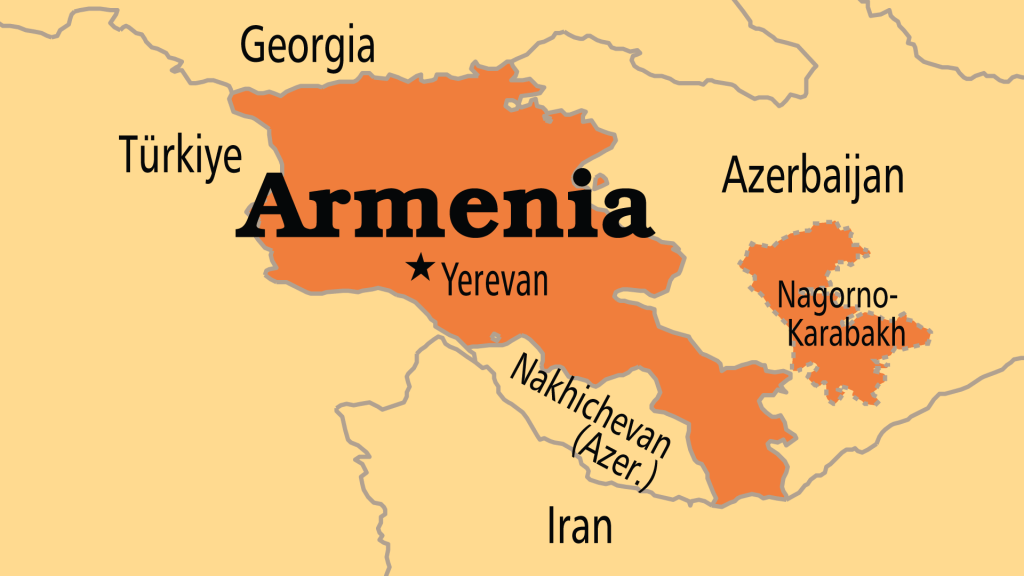
Links for further overview of Armenia:
 Stichting HEALING THE NATIONS